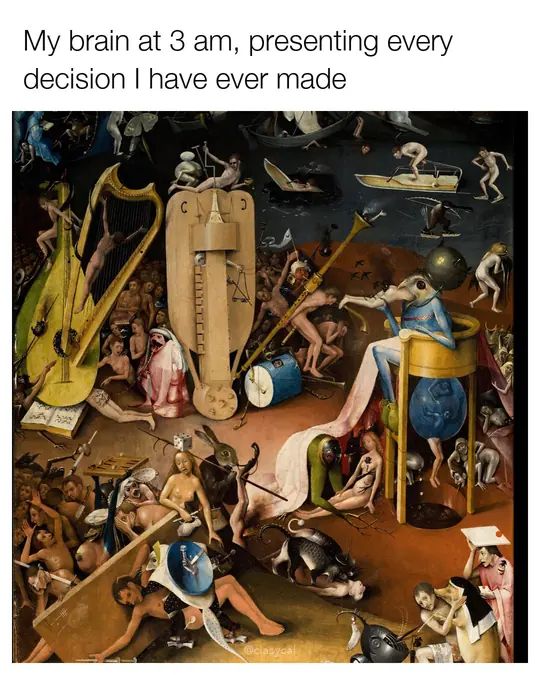
In early 2014, a college student in Oklahoma was looking at a 500-year-old painting of hell and noticed something no one had bothered to play before. Printed on the backside of a tormented sinner was a line of sheet music.
She transcribed it, recorded it and posted it online. The internet named it "the 500-year-old butt song from hell." It is, to this day, one of the greatest things to happen to art history.
First, the painting
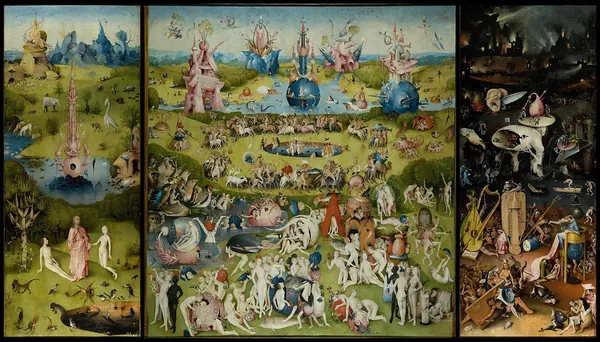
The butt belongs to The Garden of Earthly Delights, a huge folding triptych by the Netherlandish painter Hieronymus Bosch. It was painted sometime between about 1490 and 1510, and it now hangs in the Museo del Prado in Madrid.
"Bosch" is a nickname, by the way. His real name was Jheronimus van Aken. He took his professional name from his hometown, 's-Hertogenbosch, in what is now the Netherlands, where he lived most of his life until his death in 1516.
The triptych reads from left to right, and it's best summed up as a three-act story:
- Left panel: the Garden of Eden, with God presenting Eve to Adam. Peaceful, with a few deeply strange animals.
- Center panel: a vast landscape crowded with naked people, giant fruit, birds and bubbles. Scholars still argue about exactly what it means, but it's widely read as a world given over to earthly pleasures.
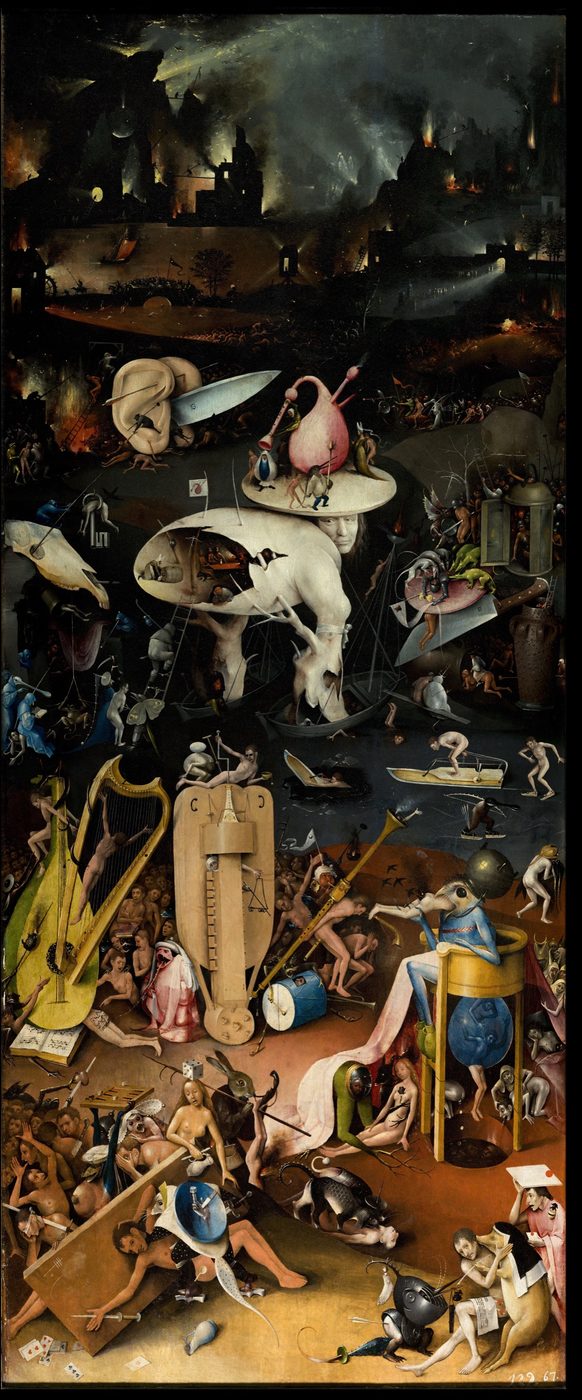
- Right panel: hell. And Bosch's hell is unlike anybody else's.
Close the wings and you get a fourth image: a calm grey globe showing the world on the third day of creation, before any humans showed up to ruin it.
Welcome to the musicians' hell
The lower part of the hell panel is often called the "musicians' hell," and it's exactly as unsettling as it sounds. Giant instruments have turned into torture devices. A man is stretched across the strings of a harp. Others are crushed beneath a lute and a drum. A hurdy-gurdy towers over the crowd, and a choir of the damned sings from a score.
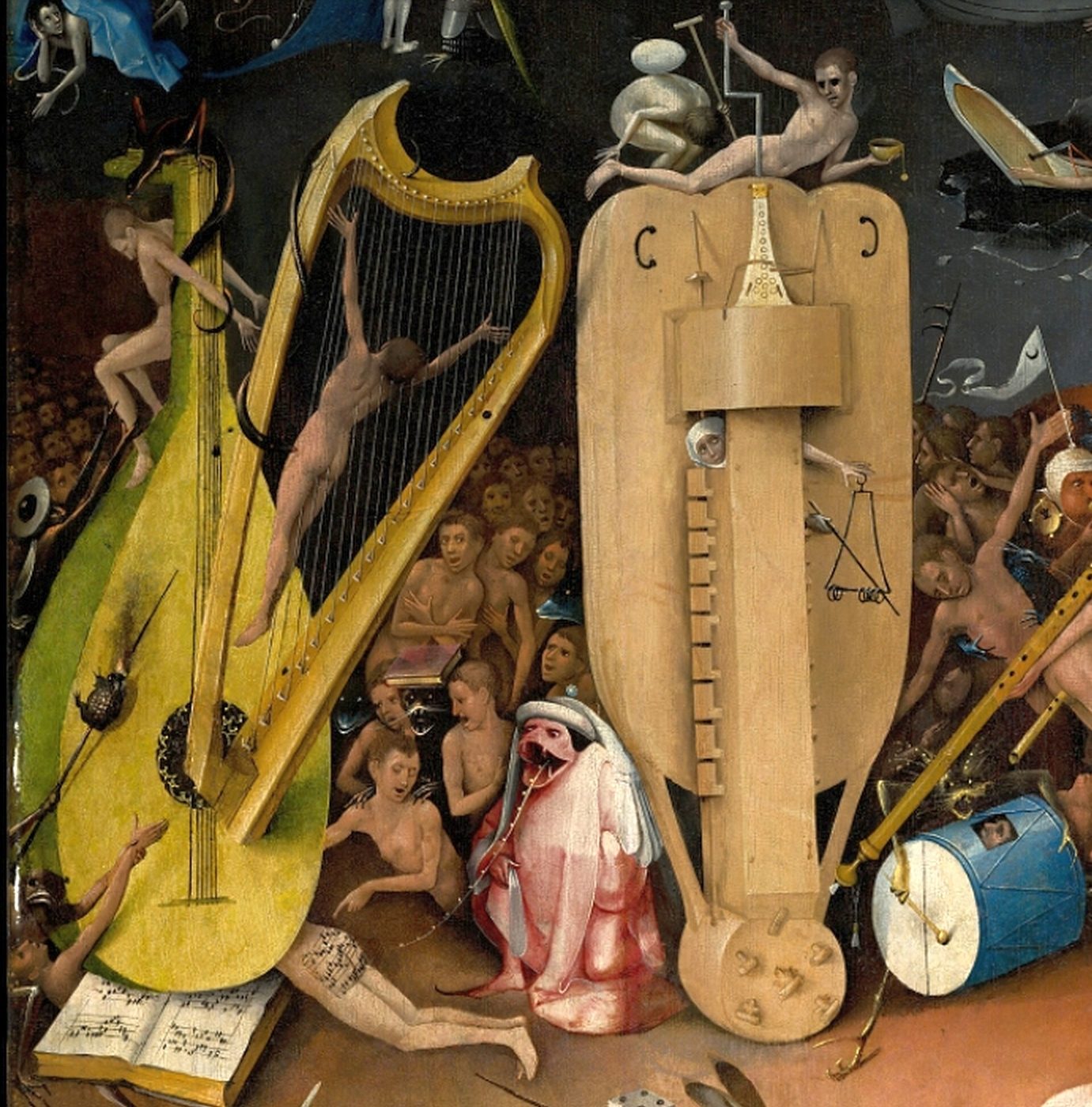
And there, near the bottom, a sinner lies face down, pinned beneath a giant lute, with a short musical score printed across his buttocks. The choir appears to be singing from it. Nobody tell them.
Why music in hell? Scholars have linked the instruments to lust and temptation, the so-called "music of the flesh," a moral idea that pleasurable sounds could lead souls astray. Some also read the scene as a dig at wandering minstrels. Whatever Bosch intended, he clearly put real effort into making it absurd.
The student who played the butt
Enter Amelia Hamrick, then a student at Oklahoma Christian University. In early 2014 she zoomed in on the notation, transcribed it into modern sheet music and recorded a version. To get there, she had to make a guess: she assumed the second line of the staff was a C, which is common in chant notation of that era.
She posted it on her Tumblr, and it took off. Within days the "butt song from hell" was everywhere, from music blogs to the Associated Press newswire.
What does it sound like? A short, slightly mournful melody, somewhere between a hymn and a funeral march. Hamrick herself was refreshingly honest about its quality. She said she played it through several times and that it's "not a very good Gregorian chant," and suggested Bosch may have just been putting notes up there to make it look like music. Since then, plenty of musicians have arranged it for choirs, lutes, synths and more.
Is it a real song?
Probably not in the sense of a melody Bosch meant anyone to perform. There's no evidence that it quotes an existing piece, and the transcription depends on modern assumptions about clefs and rhythm. What it is, unmistakably, is believable music: notation convincing enough that a choir in hell could plausibly read from it.
That's the charm. It's a 500-year-old joke that only works once someone takes it completely seriously.
Everything else happening in Bosch's hell
The butt song is just one detail in a panel packed with them. While you're there, look for:
- The bird-headed monster. Often called the "Prince of Hell," he sits on a kind of throne or toilet, wearing a cauldron as a hat, swallowing sinners whole and passing them out the other end into a pit.
- The tree-man. A huge figure whose body is a broken eggshell resting on tree-trunk legs, with a tavern scene inside him. His face looks back over his shoulder with a strange half-smile. Some scholars, notably the art historian Hans Belting, have suggested it might be a self-portrait of Bosch himself.
- Giant ears with a knife. A pair of ears pierced by an arrow, with a blade sticking out between them, rolling across the scene like a tank.
- Frozen lake. Up in the middle ground, sinners skate and fall through ice, a surprisingly wintry touch for hell.
How it ended up in Madrid
The triptych's journey is almost as wild as its contents. It was first recorded in 1517 in the palace of the Counts of Nassau in Brussels, a year after Bosch's death. It was confiscated by the Duke of Alba in 1568 and taken to Spain, where King Philip II, a huge Bosch fan, acquired it in 1591. He sent it to his palace-monastery of El Escorial in 1593, and it stayed there for more than three centuries before moving to the Prado in 1939.
Which means one of the most bizarre paintings in history spent over 300 years in a monastery. The monks must have had questions.
Why Bosch still feels so online
Bosch's imagery is surreal, crowded and full of tiny jokes that reward zooming in. Long before infinite scroll, he made a painting you could get lost in for hours, with a weird little surprise in every corner. That's why his details turn up in memes, album covers and tattoo studios all over the world.
For more classic weirdness, see the most memed paintings of all time or famous paintings that lie to you. And if you prefer your hell in black and white, our free coloring pages are a calmer option.
Five centuries old and still playing bangers from below. Follow @clasycal on Instagram for more art history you can't unsee.
Sources
- The Garden of Earthly Delights, Wikipedia
- Museo del Prado: The Garden of Earthly Delights Triptych
- Associated Press via The Washington Times: Okla. college student uncovers hidden song (2014)
- Medievalists.net: 500-year-old song found on butt in hell
- Artnet News: Bosch butt song from hell
- Classic FM: Hear the music printed on a man's bottom in a Renaissance painting